Reading the Mahavamsa by Kristin Scheible
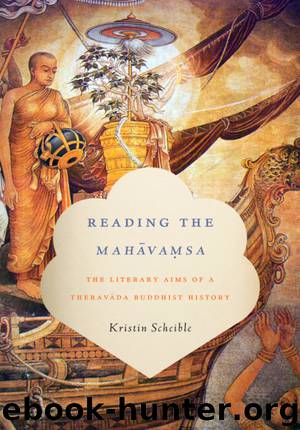
Author:Kristin Scheible
Language: eng
Format: epub
Tags: REL007040, Religion/Buddhism/Theravada, REL007010, Religion/Buddhism/History
Publisher: Columbia University Press
Published: 2016-11-01T04:00:00+00:00
TEXTUAL COMMUNITIES: WRITERS AND READERS IN CONTEXT
Much of how contemporary scholars of Buddhism, Sri Lankans, and Buddhists have understood the Mahāvaṃsa to date is predicated upon the particular cultural and historical situatedness of our own interpretive abilities, lenses, and inclinations.9 We also encounter texts through the various ways they have been interpreted in the past. This is particularly true for a text such as the Mahāvaṃsa, which has later extensions as well as a medieval commentary on it. Can we ever escape who we are and how we have learned to think about texts long enough to allow for a text to work upon us on its own terms? Does a text even have its own terms, and can a contemporary reader connect with a text directly, without intervening interpretive layers coloring the experience? Just as our own historical and cultural circumstances delimit the ways we interpret texts, so the circumstances of the fifth-century Mahāvihāra author-compiler of the Mahāvaṃsa colored his reformulation of the narratives in the Mahāvaṃsa.
The primary key employed to unlock the hidden meanings of the Mahāvaṃsa and for fleshing out the scanty data available about its historical context is its medieval commentary Vaṃsatthappakāsinī. The exact date of composition of this text is unknown. The earliest it could have been written would have been after the reign of Dāṭhopatissa II (659–667 C.E.).10 It is referred to in other texts by the thirteenth century. Whereas Mahāvaṃsa editor and translator Wilhelm Geiger dated the Vaṃsatthappakāsinī to 1000–1250, based on his assumption that the text references the tenth-century Bodhivaṃsa in its present form,11 G. P. Malalasekera dates it much earlier, citing the fluid nature of texts prior to critical editions. He suggests that it was written in much closer temporal proximity to the Mahāvaṃsa, believing that there is evidence in the text to suggest that the “original sources” for the Mahāvaṃsa “were still being studied” while the commentary was being written. As Malalasekera writes, “Since Mahānāma [the author-compiler of the Mahāvaṃsa] is generally believed to have lived in the sixth century [C.E.], it would not, I feel, be too early to assign the author of the MṬ [the Vaṃsatthappakāsinī] to about two or three centuries later, the eighth or ninth century. This would also allow sufficient time for variant readings to develop in the [Mahāvaṃsa] text.”12 Whether we follow Geiger or Malalasekera’s dating, we know that the Vaṃsatthappakasinī was written at least a few centuries after the Mahāvaṃsa and thus represents the concerns of an entirely different community than that which produced the Mahāvaṃsa. The Vaṃsatthappakasinī follows the narrative of the Mahāvaṃsa quite closely, although it chooses to elaborate on some sections far more than others. Both early translators, George Turnour and Wilhelm Geiger, used the commentary to read and translate the Mahāvaṃsa. The commentary does elucidate otherwise hard-to-render passages of the Mahāvaṃsa, but it nonetheless represents later concerns and values used to interpret the text and not necessarily the concerns and values of the Mahāvaṃsa itself.
Likewise, reading the later section
Download
This site does not store any files on its server. We only index and link to content provided by other sites. Please contact the content providers to delete copyright contents if any and email us, we'll remove relevant links or contents immediately.
The Way of Zen by Alan W. Watts(6621)
Ego Is the Enemy by Ryan Holiday(5455)
The Art of Happiness by The Dalai Lama(4133)
The Book of Joy by Dalai Lama(3996)
Why Buddhism is True by Robert Wright(3459)
Spark Joy by Marie Kondo(3310)
Shift into Freedom by Loch Kelly(3203)
Happiness by Matthieu Ricard(3054)
A Monk's Guide to a Clean House and Mind by Shoukei Matsumoto(2920)
The Lost Art of Good Conversation by Sakyong Mipham(2662)
The Meaning of the Library by unknow(2579)
The Unfettered Mind: Writings from a Zen Master to a Master Swordsman by Takuan Soho(2317)
The Third Eye by T. Lobsang Rampa(2273)
Anthology by T J(2217)
Red Shambhala by Andrei Znamenski(2207)
The Diamond Cutter by Geshe Michael Roach(2069)
Thoughts Without A Thinker: Psychotherapy from a Buddhist Perspective by Epstein Mark(2030)
Twilight of Idols and Anti-Christ by Friedrich Nietzsche(1898)
Advice Not Given by Mark Epstein(1884)
